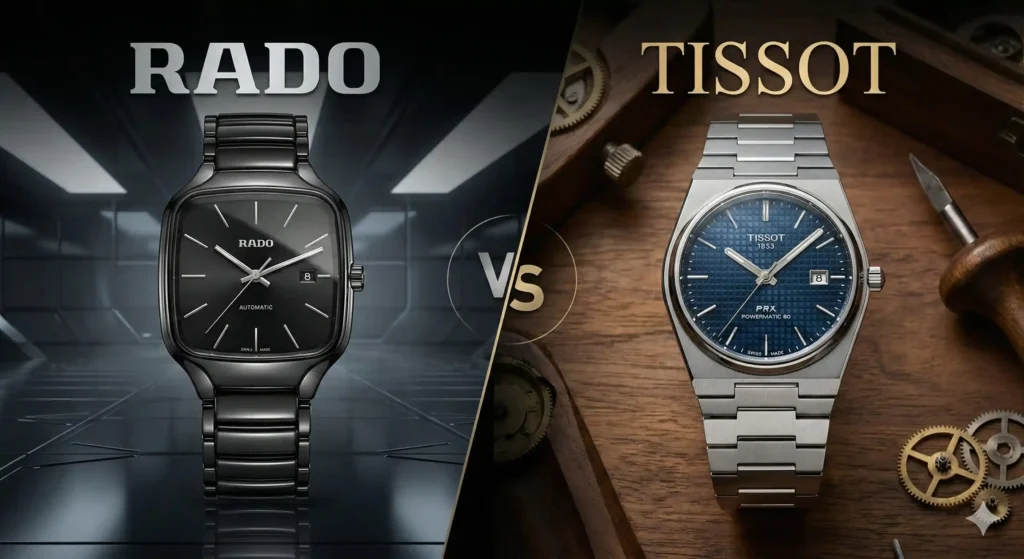
The horological landscape of 2026 has crystallized around a specific set of consumer demands that were only nascent in the early 2020s. The “Petite Grandeur” movement—a shift away from oversized wrist-weights toward refined, historically proportional, and ergonomically optimized timepieces—has reshaped product roadmaps across the Swiss watch industry. Within this evolving market, the competition between Rado and Longines, both titans under the Swatch Group umbrella, represents a fascinating case study in divergent brand strategies targeting the same demographic slice: the $2,000 to $4,500 luxury diver segment.
This report provides an exhaustive analysis of the 2026 editions of the Rado Captain Cook and the Longines HydroConquest. It explores not just the specifications, but the underlying engineering philosophies, material sciences, and market psychologies that define these two product lines. While Longines doubles down on “accessible complexity” with its expansion of “True GMT” movements and silicon technology in the HydroConquest, Rado continues to assert its dominance as the “Master of Materials,” pushing the boundaries of monobloc high-tech ceramic construction and skeletonization in the Captain Cook lineage.
The analysis draws upon extensive market data, technical specifications, and enthusiast sentiment from 2025-2026 to offer a definitive guide for collectors, retailers, and industry observers. It dissects the implications of the new 39mm “Ocean Ready” Captain Cook models, the ergonomic triumphs (and failures) of the HydroConquest GMT’s micro-adjustment systems, and the long-term value propositions of steel versus ceramic in an increasingly volatile secondary market.
1. Brand Philosophy and Historical Trajectory
1.1 Longines: The Weight of History and the Pursuit of Precision
To understand the 2026 HydroConquest, one must first appreciate the burden of heritage that Longines carries. Founded in 1832 in Saint-Imier, Longines is not merely a watch manufacturer; it is a historical institution that once rivaled Rolex and Omega in prestige and technical innovation. The brand’s winged hourglass logo is the oldest active trademark in the registry, symbolizing a legacy of aviation pioneering and chronometric excellence.
However, the post-Quartz Crisis era saw Longines repositioned within the Swatch Group hierarchy. It was tasked with dominating the “High Range” sector, sitting just below Omega. This positioning dictates the engineering choices seen in the 2026 HydroConquest. The focus is on “safe” luxury—designs that are universally palatable, movements that are reliable workhorses (derivatives of ETA architectures), and a brand image that exudes traditional Swiss elegance.
The HydroConquest, introduced in 2007, was Longines’ answer to the modern dive watch demand. Unlike the Legend Diver, which looks backward to the Super-Compressor era, the HydroConquest was designed to be contemporary. In 2026, this philosophy has evolved into a “utilitarian luxury” aesthetic. The introduction of the GMT complication into the core lineup signifies Longines’ acknowledgment of the modern consumer’s lifestyle, where international travel and remote work have made the ability to track multiple time zones as valuable as water resistance. The brand appeals to the “Rational Investor”—a consumer who values brand equity, resale stability, and classic aesthetics over experimentalism.
1.2 Rado: The Alchemist of Lengnau
Rado’s history is shorter but arguably more disruptive. Starting as a movement supplier (Schlup & Co.) in 1917, the brand didn’t emerge as “Rado” until the 1950s. Its defining moment came in 1962 with the DiaStar, the world’s first scratch-proof watch made of tungsten carbide. This cemented Rado’s identity not as a traditional watchmaker, but as a materials engineering firm that happens to make watches.
The Captain Cook, also launched in 1962, was a relatively obscure diver during its original run. Its revival in 2017 was a masterstroke of “Neo-Vintage” timing, tapping into a market hungry for skin-divers and retro aesthetics. However, by 2026, Rado has done something unique: they have fused their two identities. The Captain Cook High-Tech Ceramic models take the 1962 design language—the inward-sloping bezel, the arrow hands, the domed crystal—and render it in materials that belong in the aerospace industry.
Rado targets the “Aesthetic Innovator”—a consumer who is less concerned with the resale value of a steel sports watch and more interested in the tactile experience of ceramic, the visual depth of skeletonized dials, and the narrative of wearing a “future-proof” object. Rado is the Swatch Group’s laboratory, allowed to take risks with plasma ceramics and colors that the more conservative Longines would never attempt.
2. Material Science: The Battle of Steel vs. Ceramic
2.1 The Case for 316L Stainless Steel (Longines)
The Longines HydroConquest series utilizes 316L stainless steel, the industry standard for luxury timepieces. This alloy is chosen for its balance of corrosion resistance, polishability, and tensile strength.
- Impact Resistance: Steel is ductile. In the event of a catastrophic impact (e.g., dropping the watch on a tile floor), steel will dent or deform but rarely shatter. This makes the HydroConquest a theoretically “safer” tool for rough environments like commercial diving or rock climbing, where sharp impacts are common.
- Refinishing Potential: A scratched steel case can be polished or laser-welded back to near-factory condition during a service. This contributes to the longevity of the watch as an heirloom piece.
- Weight and Presence: The HydroConquest has a substantial heft. A 43mm GMT model on a steel bracelet can weigh upwards of 180 grams. For many American consumers, this weight is equated with “quality” and “value,” providing a reassuring presence on the wrist known as the “arm anchor” effect.
However, steel has a fundamental weakness: hardness. 316L steel measures approximately 150-200 Vickers (HV). It scratches easily. “Desk diving” marks on the clasp and hairline scratches on the polished case flanks are inevitable within days of wear. Longines mitigates this by using ceramic inserts for the bezel—the part most prone to impacts—but the case itself will show its age.
2.2 The Case for High-Tech Ceramic (Rado)
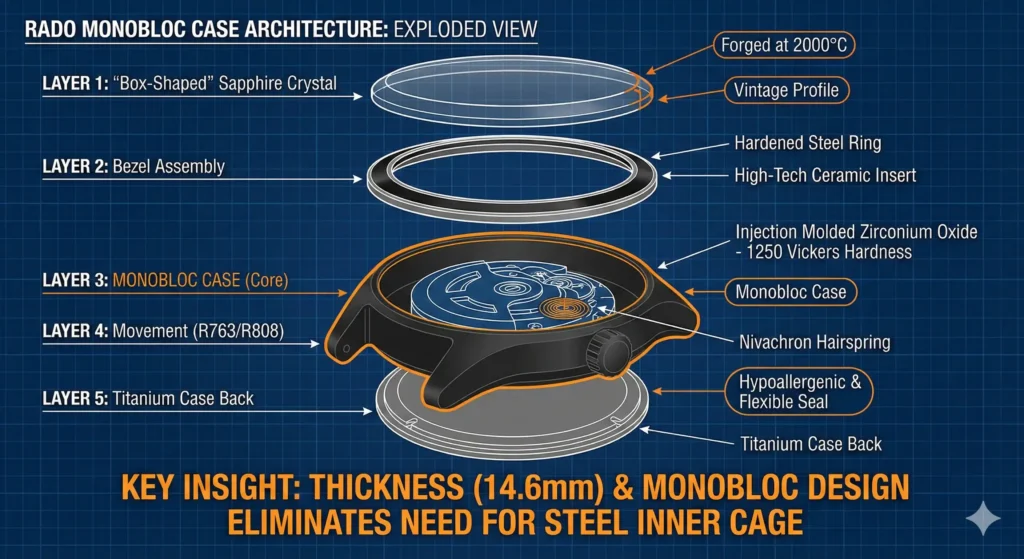
Rado’s “High-Tech Ceramic” is a zirconium oxide-based compound that is injection-molded and sintered at extreme temperatures. This is not a coating; solid ceramic forms the entire monobloc case.
- Extreme Hardness: Rado’s ceramic rates roughly 1,250 Vickers—nearly ten times harder than steel. A Captain Cook purchased in 2026 will likely look identical in 2036, free of the swirls and scratches that plague steel watches.
- Thermal Comfort: Ceramic has low thermal conductivity. It adapts quickly to body temperature, avoiding the jarring cold of steel in winter or the sticky heat in summer. It is also hypoallergenic, making it the only choice for those with nickel sensitivities.
- Lightweight Durability: The ceramic Captain Cook models are significantly lighter than their steel counterparts. A 43mm ceramic head weighs roughly 114-159 grams depending on the strap/bracelet combination, compared to the 180g heft of the steel Longines.
- The “Plasma” Process: Rado’s proprietary plasma treatment creates a metallic, gunmetal-like sheen on the ceramic without using any metal. This is achieved by activating gases at 20,000°C, altering the molecular structure of the ceramic surface.
The downside of ceramic is brittleness. While it can withstand immense pressure (hence the monobloc construction passing 5000G shock tests), it has a lower fracture toughness than steel. A direct impact on a hard surface carries a non-zero risk of cracking a lug or the case body—a catastrophic failure that cannot be repaired, only replaced. Furthermore, the manufacturing complexity necessitates a thicker case structure to ensure structural integrity, often pushing ceramic models to 14.6mm thickness compared to the 12.9mm of the steel HydroConquest.
3. Design and Aesthetics: Neo-Vintage vs. Modern Utility
3.1 Rado Captain Cook: The Art of Retro-Futurism
The aesthetic genius of the 2026 Captain Cook lies in its ability to simulate vintage charm using modern tech.
- The Crystal: Rado uses a “box-shaped” sapphire crystal. In the 1960s, this shape was achieved with acrylic (Hesalite), which was prone to scratching. Rado’s sapphire mimics the distortion and warmth of acrylic—creating charming refractions of the dial indices at extreme angles—but with diamond-like scratch resistance.
- The Dial: The 2026 models often feature gradient or “fumé” dials that fade from a vibrant center (turquoise, green, terracotta) to a black periphery. This simulates the aging process of vintage dials (tropicalization) but is executed with deliberate precision.
- The Anchor: The rotating anchor logo at 12 o’clock is a beloved Rado quirk. Mounted on a ruby bearing, it spins freely with the movement of the wrist. Originally designed to indicate when service was needed (if the anchor stopped spinning, the oils were dried up), today it is a kinetic sculpture that delights enthusiasts.
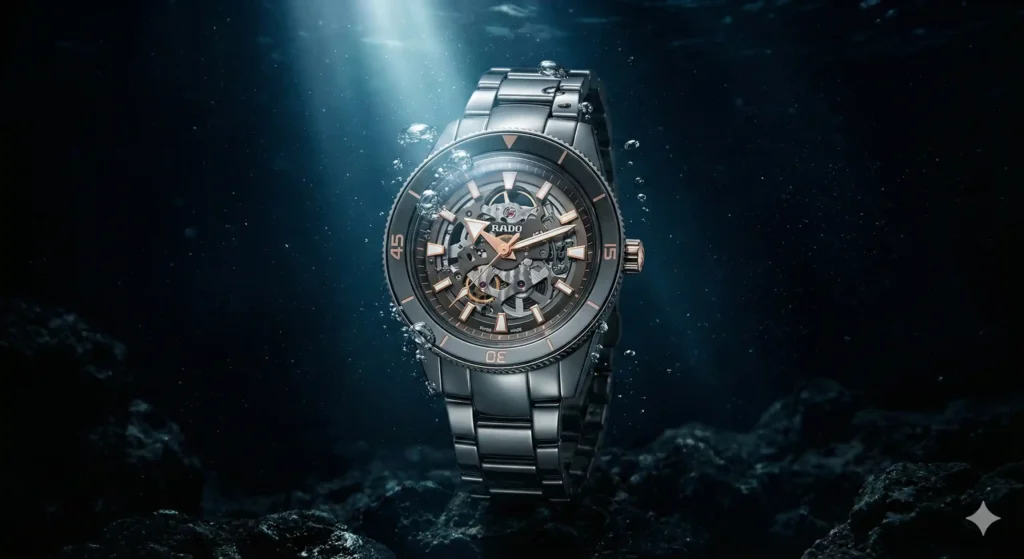
- Skeletonization: The “Anatomy” of the movement is on display in the High-Tech Ceramic Skeleton models. Rado uses tinted crystals (grey or blue) to allow visibility of the movement without compromising legibility, a technique that adds depth and technical intrigue.
3.2 Longines HydroConquest: The Modernist Tool
The HydroConquest creates a stark contrast with its unapologetically modern design language. It does not try to be a vintage reissue; that role is left to the Longines Legend Diver.
- The Dial: Longines employs a “Sunray” finish on most HydroConquest dials. This radial brushing catches light dynamically, giving the watch a jewelry-like flash that appeals to the general luxury consumer. The indices are applied circles and expansive Arabic numerals at 12, 6, and 9 (on non-GMT models), heavily filled with Super-LumiNova.
- The Bezel: The bezel action on the HydroConquest is engineered for tactile precision. It features a ceramic insert with a focused, modern font. The knurling on the bezel edge is aggressive, designed for grip with wet hands or gloves.
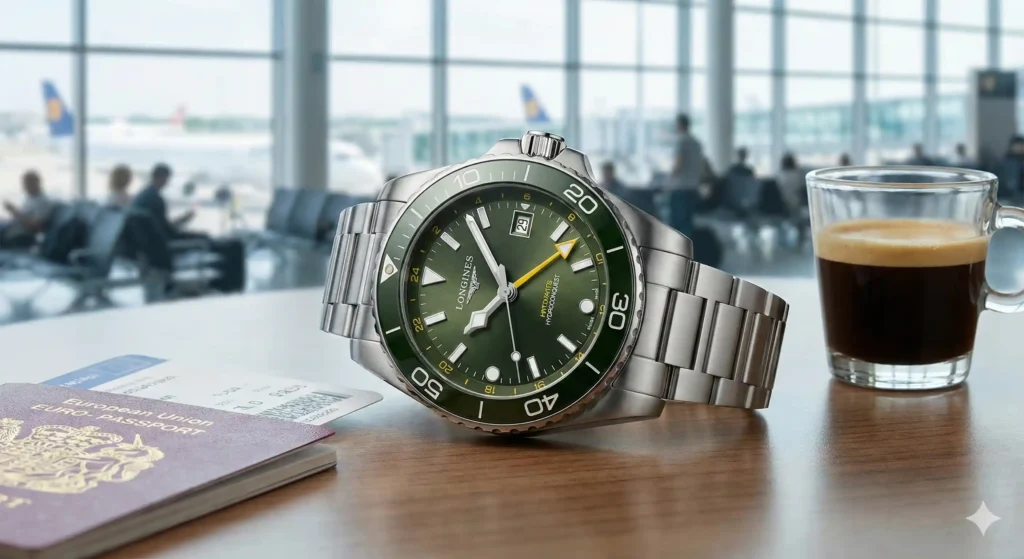
- The GMT Integration: On the GMT models, the design is surprisingly cleaner. The large Arabic numerals are replaced by simpler geometric indices to reduce clutter, allowing the 24-hour scale on the flange (rehaut) to be readable. The GMT hand usually features a distinct color pop (orange or blue) and a lumed “lozenge” tip, prioritizing legibility.
3.3 Dimensions and The “Petite Grandeur” Shift
2026 has seen a definitive market correction regarding size. The “Petite Grandeur” trend emphasizes wearable luxury.
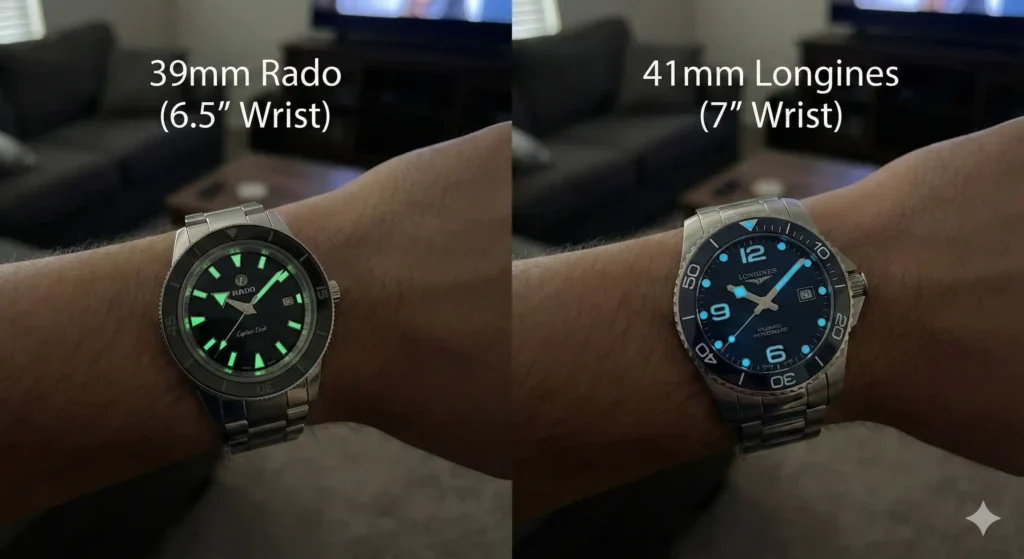
- Rado 39mm: Rado has responded aggressively by moving the 39mm Captain Cook from limited editions to the core collection. With a lug-to-lug distance of just 45.5mm, this watch fits a vast range of wrists, addressing the complaint that the 42mm (49mm L2L) and 43mm (50mm L2L) models were too large for the prevailing trend.
- Longines 41mm vs. 43mm: Longines offers the HydroConquest GMT in both 41mm and 43mm. The 41mm model, with a lug-to-lug of roughly 49.2mm and a thickness of 12.9mm, is the volume seller in the USA market. It strikes the balance between presence and comfort. The 43mm version (approx. 52-53mm L2L) remains popular in markets that prefer larger watches but is increasingly seen as an “outlier” size in the high-fashion context.
4. Movement Technology: The Powermatic vs. The L888/L844
Both brands benefit from the industrial might of ETA (Swatch Group), but their movements are tuned to different philosophies.
4.1 Rado Calibre R763 (Powermatic 80 Derivative)
- Base Architecture: ETA C07.611.
- Beat Rate: 21,600 vibrations per hour (3 Hz).
- Power Reserve: 80 Hours.
- Hairspring: Nivachron™.
- Analysis: The R763 is designed for the modern lifestyle of “rotation.” The 80-hour power reserve means a user can take the watch off on Friday evening and put it back on Monday morning without it stopping. This convenience is achieved by lowering the frequency to 3 Hz. While this results in a slightly “stuttering” second hand (6 beats per second) compared to higher-beat watches, the trade-off is widely accepted for the extended autonomy.
- Nivachron: Rado’s use of the Nivachron hairspring (a titanium alloy) provides exceptional protection against magnetic fields and temperature variations. It is robust and shock-resistant, aligning with the “toughness” ethos of the Captain Cook.
4.2 Longines Calibre L844.5 (GMT) and L888.5 (Three-Hand)
- Base Architecture: ETA A31.L01 (heavily modified).
- Beat Rate: 25,200 vibrations per hour (3.5 Hz).
- Power Reserve: 72 Hours.
- Hairspring: Monocrystalline Silicon.
- Analysis: Longines opts for a “middle ground” frequency of 3.5 Hz (7 beats per second). This offers a smoother sweep than Rado while still maintaining a weekend-proof 72-hour reserve. It is a technically impressive compromise that signals a slightly more “premium” positioning.
- Silicon: The use of a silicon balance spring is a key differentiator. Silicon is impervious to magnetism (antimagnetic), lightweight, and requires no lubrication. It contributes to higher isochronism (accuracy over time). However, silicon is brittle; unlike metal springs that can be reshaped by a watchmaker, a damaged silicon spring must be replaced entirely.
- True GMT Function: The L844.5 is a “Flyer” or “Traveler” GMT. This means the local hour hand can be jumped forward or backward in one-hour increments independently of the minute hand. This is the preferred functionality for actual travelers crossing time zones, as opposed to “Caller” GMTs (like the ETA 2893) where the 24-hour hand is quick-set. This elevates the HydroConquest GMT above many competitors in its price bracket.
5. Wearability, Ergonomics, and The “Gorpcore” Factor
5.1 Bracelet Engineering and The Micro-Adjust Revolution
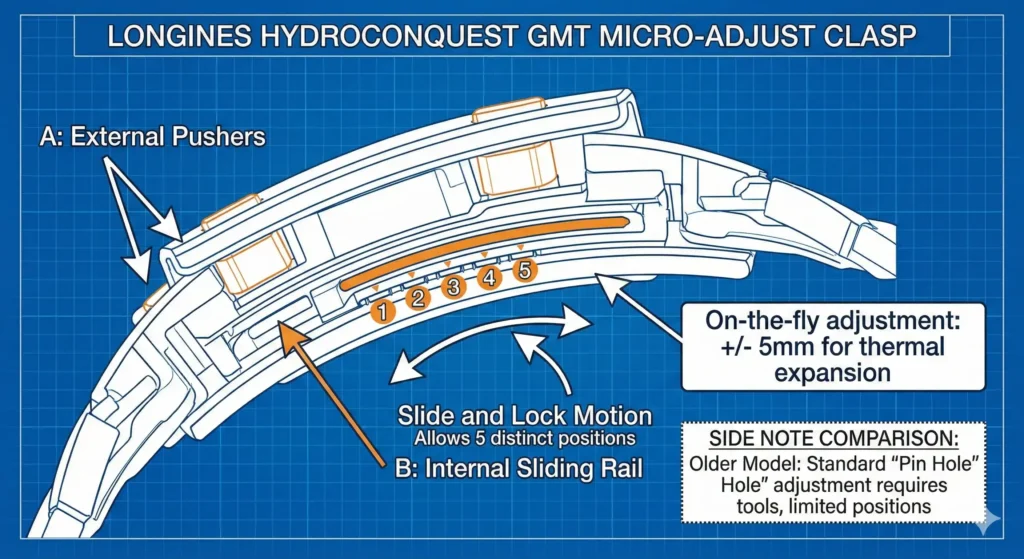
One of the most significant upgrades for Longines in the 2025-2026 cycle was the introduction of a toolless micro-adjustment clasp on the HydroConquest GMT.
- Longines: The new clasp allows the wearer to expand or contract the bracelet length by several millimeters on the fly. This addresses the phenomenon of wrist swelling due to heat or humidity. For a heavy steel watch, this feature is critical for maintaining comfort throughout the day. However, entry-level non-GMT models may still ship with the older, friction-fit clasps, which have been criticized for being difficult to open and feeling “cheap”.
- Rado: The Captain Cook’s “Beads-of-Rice” bracelet is legendary for its comfort. The many small links drape over the wrist like fabric, eliminating hair-pulling and conforming to irregular wrist shapes. However, the high-tech ceramic bracelets on the skeleton models use a titanium butterfly clasp (to maintain the seamless look) which lacks micro-adjustment. Getting a perfect fit often requires adding or removing half-links, which is less convenient than the Longines system.
5.2 Strap Options and Style
- Gorpcore Trend: The “Gorpcore” fashion trend—incorporating functional outdoor gear into daily style—has boosted the popularity of rubber and NATO straps.
- Longines: Offers high-quality rubber straps that are integrated into the case flanks for a seamless look. However, durability concerns have been raised, with reports of cracking after 18 months of heavy use.
- Rado: The ceramic models are often paired with rubber straps that feel integrated but are distinctly comfortable due to the lightness of the watch head. The matte finish of the ceramic pairs exceptionally well with the utilitarian vibe of rubber, fitting the “urban explorer” aesthetic perfectly.
6. Durability and Reliability: Real-World Analysis
6.1 Common Failure Points
- Longines Crown Stripping: A recurring issue noted in enthusiast forums involves the screw-down crown of the HydroConquest. Users have reported a “gritty” feeling and, in some cases, stripped threads after repetitive use. This is often attributed to user error (cross-threading) but also points to a potential weakness in the crown tube material or machining tolerances.
- Rado Bezel Action: While visually stunning, the bezel action on the Captain Cook has been described as having “backplay”—a slight looseness or wiggle before the click engages. While not a functional failure, it detracts from the perceived quality compared to the tight, crisp clicks of the Longines.
- Rado Winding Feel: The Powermatic 80 movement can sometimes feel “gritty” or “spongy” when manually wound, a characteristic of the winding mechanism’s gear ratios designed to handle the mainspring tension required for 80 hours of reserve.
7. Market Analysis: Value, Competition, and Demographics
7.1 USA Market Demographics
- Longines Consumer: Skews slightly older (35-55) or more traditional. Likely a professional (finance, law, engineering) buying a “one good watch” that can be worn with a suit or jeans. Values brand recognition and heritage. View the watch as a status symbol and an asset.
- Rado Consumer: Skews younger (25-45) or design-focused (architects, creatives, tech sector). Values differentiation—they don’t want the same Submariner-style watch as their boss. They are attracted to the “tech” aspect of ceramic and the skeletonized aesthetic.
7.2 Resale Value and Investment
Longines is the clear winner for liquidity. A HydroConquest is a known quantity; it sells quickly on the secondary market (eBay, Chrono24, forums) and retains 60-70% of its value if in good condition. Rado suffers from higher initial depreciation. A ceramic Captain Cook might lose 40-50% of its retail value immediately upon purchase. However, the long-term condition of the Rado helps it. A 5-year-old Rado often looks brand new due to the scratch-proof case, whereas a 5-year-old Longines will show scratches. This “condition bonus” helps Rado stabilize its price floor in the long run.
7.3 Competitive Landscape
- Tudor Black Bay: The elephant in the room. The Black Bay sits slightly higher in price ($3,500-$4,500) but exerts massive pressure on the $3,000+ segment. Longines competes by offering similar specs (GMT, silicon, 70hr PR) for $500-$1000 less.
- Oris Aquis: Direct competitor to Rado in terms of modern design. Oris pushes its in-house Calibre 400. Rado counters with the unique selling point of ceramic materials.
8. Detailed Comparison of 2026 Key Models
Rado Captain Cook 39mm vs. Longines HydroConquest 41mm
| Feature | Rado Captain Cook 39mm (2026) | Longines HydroConquest 41mm |
| Reference (Example) | R32223203 (Blue Gradient) | L3.781.4.96.6 (Sunray Blue) |
| Price (USD) | ~$2,650 | ~$2,000 |
| Case Material | Polished Stainless Steel | Brushed/Polished Stainless Steel |
| Bezel | High-Tech Ceramic Insert (Sloped) | Ceramic Insert (Flat) |
| Crystal | Box-Shaped Sapphire (Vintage Style) | Flat Sapphire with Multi-layer AR |
| Diameter | 39 mm | 41 mm |
| Lug-to-Lug | 45.5 mm (Very Wearable) | 50 mm (Substantial) |
| Thickness | 12 mm | 11.9 mm |
| Movement | Rado R763 (Powermatic 80) | Longines L888.5 |
| Beat Rate | 21,600 vph (3 Hz) | 25,200 vph (3.5 Hz) |
| Power Reserve | 80 Hours | 72 Hours |
| Anti-Magnetic | Nivachron™ Hairspring | Silicon Balance Spring |
| Bracelet | Beads-of-Rice (Pin & Collar) | Oyster-style (Micro-adjust on some) |
| Water Resistance | 300m (ISO 6425) | 300m (ISO 6425) |
| Vibe | Retro-Charm, Dressy Diver | Modern Tool, Sport-Luxury |
Rado Captain Cook High-Tech Ceramic vs. Longines HydroConquest GMT
| Feature | Rado Captain Cook Ceramic Skeleton | Longines HydroConquest GMT 43mm |
| Price (USD) | ~$4,500 – $5,050 | ~$3,150 – $3,350 |
| Case Material | Monobloc High-Tech Ceramic | Stainless Steel |
| Case Back | Titanium (Display) | Stainless Steel (Screw-down) |
| Diameter | 43 mm | 43 mm |
| Lug-to-Lug | 49.8 mm | ~53 mm |
| Thickness | 14.6 mm | 12.9 mm |
| Movement | Rado R808 (Skeletonized) | Longines L844.5 (True GMT) |
| Complications | Time Only (Skeleton view) | True GMT (Flyer style), Date |
| Weight | ~114g – 159g | ~180g (on bracelet) |
| Bezel | Ceramic (Visual focus) | Ceramic (Functional focus) |
| Clasp | Titanium Butterfly (No micro-adjust) | Double Safety Folding (Micro-adjust) |
| Target Audience | Design/Material Enthusiast | Traveler/Professional/One-Watch Collection |
9. Frequently Asked Questions (FAQ)
-
Which watch is better for a smaller wrist (under 6.75 inches)?
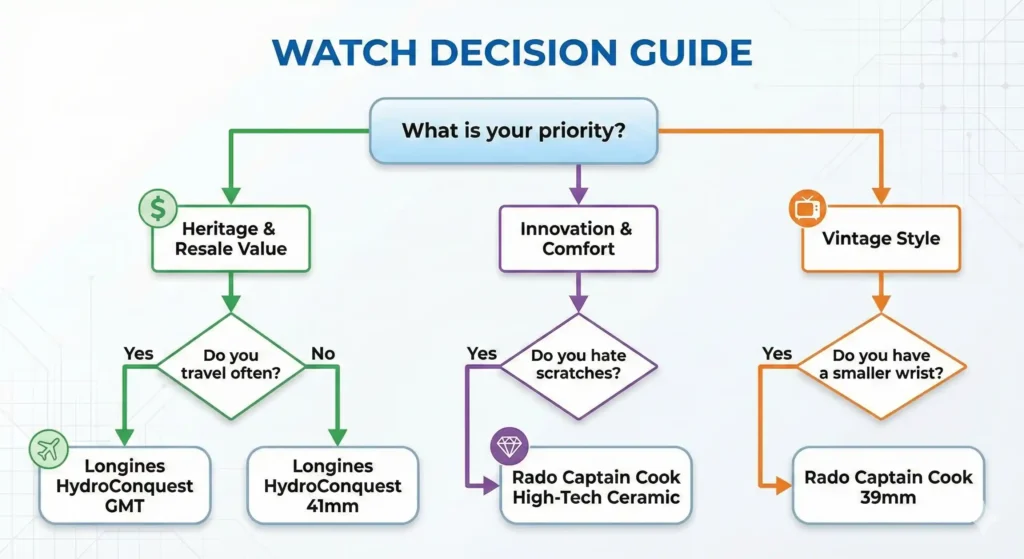
The Rado Captain Cook 39mm is the superior choice for smaller wrists. Its lug-to-lug distance is approximately 45.5mm, making it extremely compact. The Longines HydroConquest 41mm has long, straight lugs that extend the effective length to 50mm, which can overhang on smaller wrists..
-
Is the Rado ceramic case prone to shattering?
While rare, it is possible. Ceramic is extremely hard (scratch-proof) but has lower tensile strength than steel. A drop onto a hard tile or concrete surface from chest height could crack the case or a lug. The Longines steel case would only dent in the same scenario. Rado owners should treat their watch with a slightly higher degree of care regarding impact..
-
Can I swim with the Rado Captain Cook Skeleton?
Yes. Despite the “open” dial showing the movement, the Rado Captain Cook Skeleton is a fully ISO-compliant dive watch with 300 meters of water resistance, a screw-down crown, and a sealed sapphire crystal system.
-
Does the Longines HydroConquest GMT have a “jumping” hour hand?
Yes. The Calibre L844.5 inside the 2026 HydroConquest GMT is a “True” or “Traveler” GMT. This allows you to adjust the local hour hand independently in one-hour jumps without stopping the watch—ideal for changing time zones..
-
Which watch holds its value better?
Historically, Longines holds its value better in the short term (retaining 60-70%). Rado experiences steeper initial depreciation. However, a used Rado in “mint” condition (easy to maintain due to ceramic) can command a premium over a beaten-up steel watch in the long term. If you plan to sell within 2 years, buy Longines. If you keep it for 10 years, the Rado’s aesthetic durability pays off..
-
What is the service interval for these watches?
Both brands recommend a full service every 5-7 years. Since both use Swatch Group based movements (ETA derivatives), they are easy to service. However, the Longines silicon hairspring cannot be repaired, only replaced, while the Rado Nivachron spring is more traditional. Service costs are generally comparable, around $250-$400 depending on the region.
12. Conclusion: The Verdict
The choice between the 2026 Rado Captain Cook and the Longines HydroConquest is not merely a matter of specs—they trade blows evenly on water resistance (300m) and power reserve (72 vs. 80 hours). It is a choice of identity.
Choose the Longines HydroConquest if you are a pragmatist. You value the “True GMT” functionality for travel, you appreciate the security of a heavy steel bracelet with on-the-fly adjustment, and you want a watch that feels like a traditional, high-value Swiss asset. It is the “smart” buy—the watch that fits the boardroom and the beach club with equal authority.
Choose the Rado Captain Cook if you are a romantic. You are drawn to the warmth and lightness of ceramic, the mesmerizing depth of a skeletonized or fume dial, and the vintage charm of the beads-of-rice bracelet. You accept the lack of a micro-adjust clasp because the watch itself is a piece of wearable art that refuses to age. It is the “passionate” buy—a watch that sparks conversation and defies the ubiquity of steel divers.
In the battle of 2026, Longines wins the mind, but Rado captures the imagination.
Disclaimer: Prices and specifications are based on early 2026 market data and are subject to change.