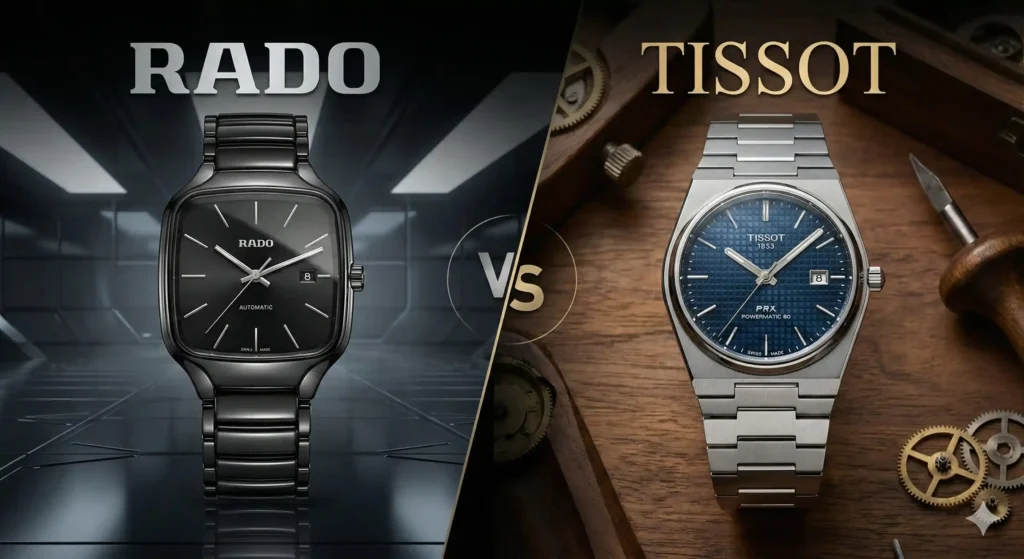
Buying your first luxury Swiss watch is a rite of passage. It is a signal that you have arrived. But standing at the counter or browsing online, the choice often narrows down to two giants of the industry: Rado and Tissot.
Both hail from Switzerland. Both belong to the massive Swatch Group family. Yet, they speak to two completely different types of men.
Is Tissot just the “budget” option, or does it offer better value? Is Rado’s high price tag purely for the shiny ceramic, or is there real horology inside?
I am The Dial Curator, and today, we are stripping away the marketing noise. We are putting these two legends head-to-head—movement against movement, material against material—to help you decide where your hard-earned money belongs.
The Heritage: Tradition vs. The Future
To understand what you are buying, you must understand where it comes from.
Tissot is the old guard. Founded in 1853 in Le Locle, Switzerland, Tissot has been making watches since before the lightbulb was invented. They position themselves as “Innovators by Tradition.” They are the gatekeepers of the Swiss watch world—offering massive volume, classic designs, and accessible pricing. If you want a watch that looks timeless and feels like a piece of history, Tissot plays that card perfectly.
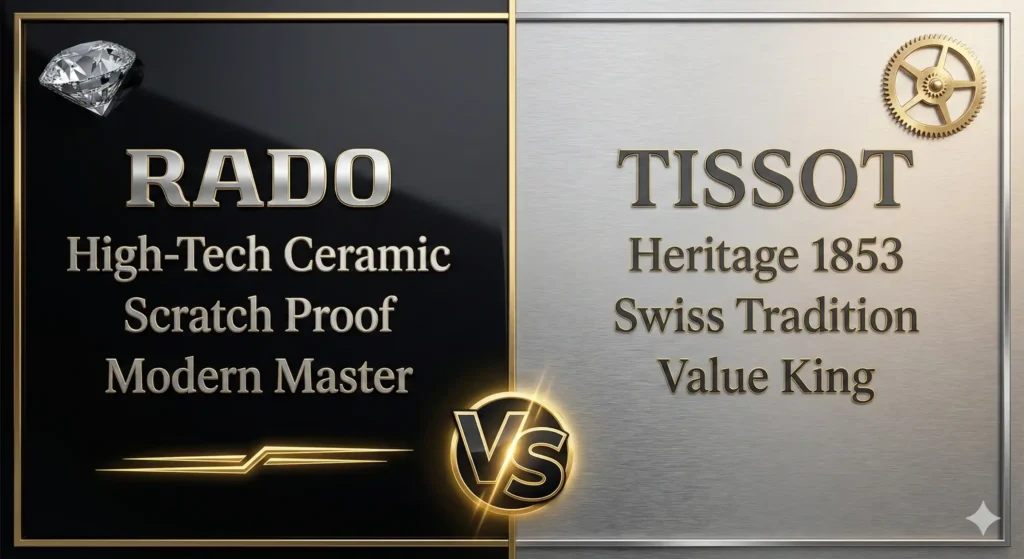
Rado, on the other hand, is the rebel. Founded much later in 1917 as Schlup & Co., they didn’t really become “Rado” until the 1950s. While Tissot was refining gold plating, Rado was obsessed with scratch-proof materials. They are known as the “Master of Materials.” Rado doesn’t care about looking like a vintage watch from the 1800s; they want to look like a watch from 2050.
The Curator’s Take: If you want tradition and history on your wrist, look at Tissot. If you want modern engineering and a watch that will look brand new for 20 years, look at Rado.
Material Science: The Major Differentiator
This is where the price gap between the two brands starts to make sense.
Rado: The Ceramic King
Rado is famous for High-Tech Ceramic. This isn’t the ceramic used in your coffee mug. This is a scientific marvel—lighter than steel, harder than gold, and hypoallergenic.
- Scratch Resistance: You can practically take a car key to a Rado ceramic bracelet, and it won’t leave a mark.
- The Feel: Ceramic warms up to your body temperature almost instantly. It feels silky and organic, unlike cold steel.
- The Look: It has a unique, metallic shine that never fades. A 10-year-old Rado often looks exactly the same as a brand-new one.
Tissot: The Steel Standard
Tissot sticks mostly to 316L Stainless Steel. This is the industry standard for luxury watches. It is robust, easy to polish, and durable.
- However, Tissot does scratch. After a year of daily wear (desk diving), a Tissot bracelet will show “swirls” and hairline scratches. This is normal for steel watches, but it lacks the eternal perfection of Rado.
Movements: What Beats Inside?
Since both brands are owned by the Swatch Group, they often share the same engines (movements) from ETA, the world’s largest movement manufacturer.
The Powermatic 80 Revolution
Both Rado and Tissot use versions of the Powermatic 80 movement. This is a game-changer in the industry.
- Power Reserve: 80 Hours. You can take your watch off on Friday evening, leave it on your dresser, and pick it up Monday morning—it will still be running.
- The Difference: While the base architecture is the same, Rado often decorates their movements better and sometimes uses a Nivachron™ hairspring in more models to resist magnetic fields better than entry-level Tissot models.
Head-to-Head: The Model Comparison
Let’s stop talking theory and look at the actual watches you are likely considering.
1. The Diver Battle: Rado Captain Cook vs. Tissot Seastar 1000
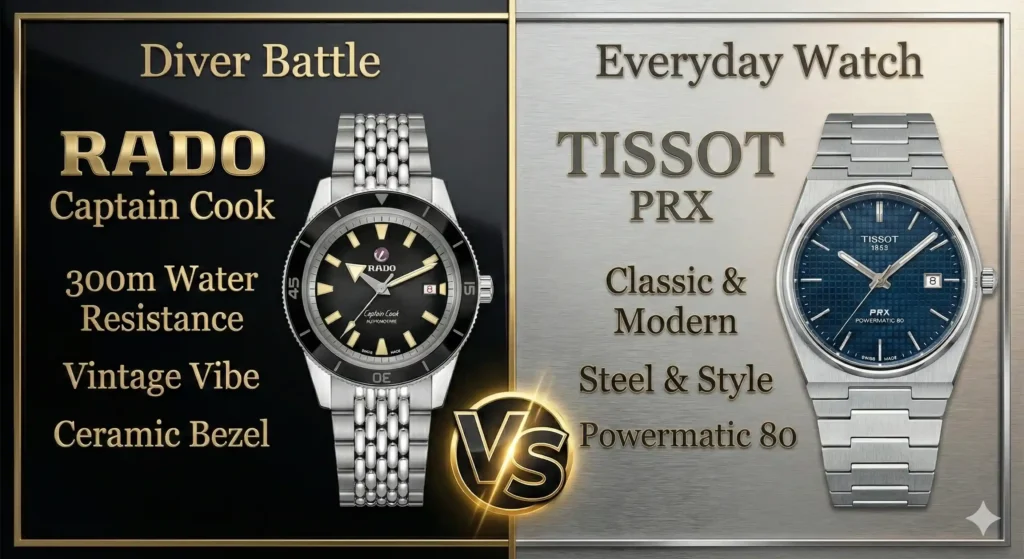
| Feature | Tissot Seastar 1000 Powermatic 80 | Rado Captain Cook Automatic |
| Price (Approx) | ₹70,000 – ₹85,000 | ₹2,00,000+ |
| Bezel Material | Ceramic insert (in newer models) | High-Tech Ceramic |
| Case Material | 316L Stainless Steel | Stainless Steel / Bronze / Ceramic |
| Crystal | Flat Sapphire | Box-Shaped Sapphire (Vintage look) |
| Water Resistance | 300m (Professional Diver) | 300m (Professional Diver) |
| Vibe | Modern, Sporty, Bulky | Vintage, Elegant, Versatile |
Winner:
- Value: Tissot Seastar. You get 300m water resistance and a ceramic bezel for under ₹1 Lakh. It is a beast.
- Style: Rado Captain Cook. The “Box Sapphire” crystal and the sloping bezel make it one of the most beautiful divers on the market. It can be worn with a suit; the Seastar cannot.
2. The Everyday Watch: Rado Centrix vs. Tissot PRX
The Tissot PRX is currently the most popular watch in the world in its segment. Its 1970s integrated bracelet design is iconic. It feels much more expensive than it is.
The Rado Centrix is the classic “Wedding Watch” of India. It uses ceramic links in the bracelet which makes it incredibly comfortable and jewelry-like.
Curator’s Note: If you are under 35, the Tissot PRX is the trendier, sharper choice. If you want something more dressy, formal, and scratch-proof for long-term daily wear, the Rado Centrix wins.
Rado vs. Tissot: The Investment Perspective
Let’s be honest—entry-level luxury watches are not “investments” like a Rolex Daytona. You will not flip these for a profit next year. However, Value Retention matters.
- Rado: Because of the ceramic material, Rados don’t look “used” easily. This helps them hold value slightly better in the private second-hand market, especially specific models like the Captain Cook.
- Tissot: Tissot is a volume brand. They make millions of watches. The resale value drops significantly the moment you walk out of the store. Buy a Tissot to keep it and love it, not to sell it.
According to data from Chrono24, the global marketplace for luxury watches, the Rado Captain Cook has seen a stable demand curve compared to the more volatile entry-level market.
The Verdict: Which One Should You Buy?
As The Dial Curator, I don’t believe in “it depends.” Here is my direct advice:
Buy a Tissot If:
- Budget is Key: You want a true Swiss Automatic watch for under ₹70,000 – ₹90,000.
- You Love History: You appreciate the classic 1853 heritage.
- You Want Versatility: The Tissot Gentleman or PRX can go from the gym to the boardroom easily.
Buy a Rado If:
- Durability is Priority: You hate seeing scratches on your watch buckle.
- You Want Unique Design: You prefer the minimalist, futuristic look over the traditional “watch” look.
- You Have a Higher Budget: You are willing to spend ₹1.5 Lakh+ for better finishing and superior materials.
Summary Table: At a Glance
| Feature | Tissot | Rado |
| Primary Material | Stainless Steel | High-Tech Ceramic |
| Price Range | Affordable Luxury (₹30k – ₹1L) | Mid-Tier Luxury (₹1L – ₹4L) |
| Style Profile | Classic, Traditional, Sporty | Modern, Minimalist, Elegant |
| Target Age | 20 – 45 | 30 – 60 |
| Movement | ETA / Powermatic 80 | ETA (Higher Grade) |
Frequently Asked Questions (FAQs)
-
Is Rado a better brand than Tissot?
In terms of hierarchy, yes. Rado sits higher on the Swatch Group luxury pyramid than Tissot. Rado uses more expensive materials (Ceramic) and has a higher average price point. However, Tissot offers better “value for money” for entry-level buyers.
-
Why is Rado so expensive compared to Tissot?
The cost comes down to manufacturing complexity. Creating high-tech ceramic cases requires sintering powder at incredibly high temperatures and diamond-tooling for finishing. Tissot primarily uses stamped stainless steel, which is cheaper to produce.
-
Does the gold color on Tissot watches fade?
Tissot uses PVD (Physical Vapor Deposition) coating for their gold models. While durable, it can eventually fade or scratch deep enough to show the steel underneath after years of heavy use. Rado’s ceramic “gold” colored watches will never fade because the color is part of the material itself (or highly advanced plasma treatment).
-
Which brand has better resale value?
Generally, Rado holds value slightly better, particularly the Captain Cook and True Square models. Tissot is mass-produced in high volumes, which keeps resale prices low, with the exception of the Tissot PRX Automatic, which is currently in high demand.
-
Can I wear my Tissot Seastar or Rado Captain Cook for swimming?
Yes. Both the Tissot Seastar and Rado Captain Cook are ISO-certified style diver watches with at least 200m-300m water resistance. They are perfectly safe for swimming and snorkeling. Just ensure the screw-down crown is tightened before entering the water.


Hi, this is a comment.
To get started with moderating, editing, and deleting comments, please visit the Comments screen in the dashboard.
Commenter avatars come from Gravatar.